
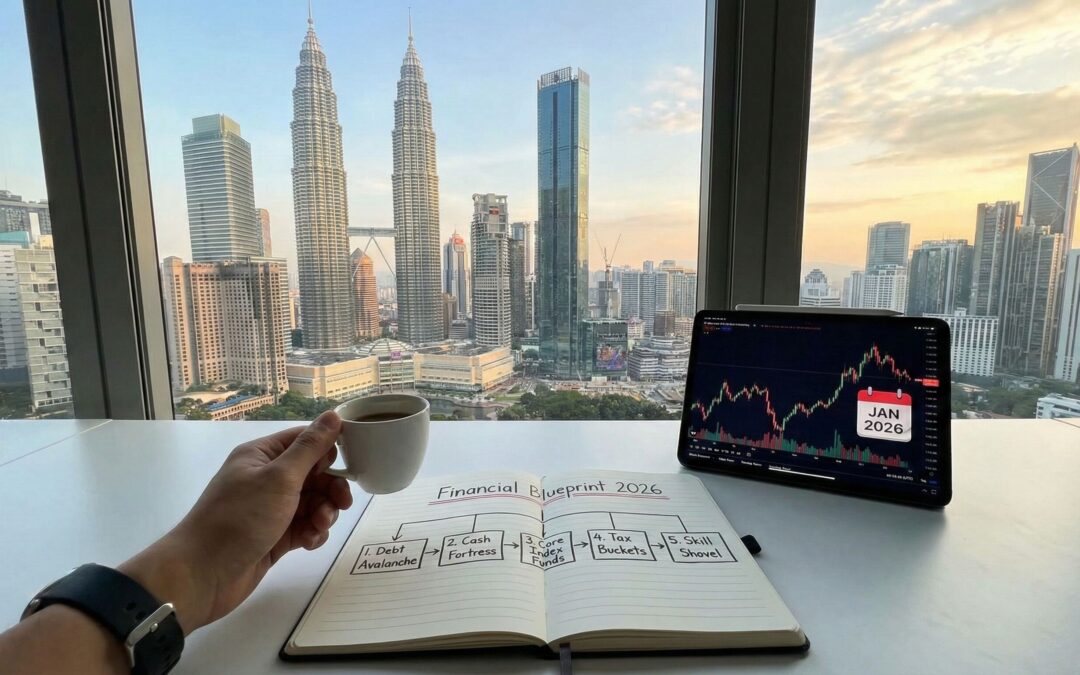
I was sitting here this morning, looking out at the skyline of Kuala Lumpur, thinking about how quickly time moves. It’s early 2026. If you’re like me, you probably spent the last week of December reflecting on where you are and where you want to go.
Maybe you’re starting today with exactly zero dollars in your investment account. Maybe there’s a little bit of debt hanging over your head like a low-hanging cloud, and your job pays the bills but doesn’t quite leave enough for the life you’ve been dreaming of. The news is full of talk about AI taking over roles, fluctuating interest rates, and a housing market that feels increasingly out of reach.
It’s easy to feel frozen. It’s easy to assume the game is rigged and decide not even to pick up the controller. But I want to share something that really shifted my perspective recently. If I had to start from absolute zero right now—knowing what I know about compounding, market cycles, and the engineering behind a solid financial plan—I wouldn’t panic. In fact, 2026 might be one of the cleanest entry points we’ve seen in a decade, provided you know how to ignore the noise.
This isn’t about getting rich by Tuesday. This is a mathematical roadmap—a “peer review” for your finances—designed to take you to your first $100,000 and beyond. Let’s walk through the five phases of this strategy together.
Phase 1: Breaking the Negative Compounding Trap
Before we can build a house, we have to clear the site. In engineering, we call this a structural integrity check. In finance, it’s about identifying the “invisible anchor” dragging you backward: high-interest debt.
I see it so often—people asking which tech ETF or crypto coin they should buy while they’re sitting on credit card debt at 20% or 24% interest. There’s a pervasive myth that you can out-invest your bad habits. But let’s look at the math, because while feelings can lie, numbers don’t.
If you have $5,000 in consumer debt at 24% interest and you only make the minimum payments, you’ll end up paying back nearly double that amount over the next decade. Meanwhile, the stock market historically returns about 10% before inflation. Mathematically, paying off that debt is a guaranteed 24% return. You simply cannot find that in the market without taking risks that could wipe you out.
This is what I call the Negative Compounding Trap. Until you fix the leak in the bucket, the water will never stay in.
The Protocol:
I use the Avalanche Method. List every liability from the highest interest rate to the lowest. Ignore the balance size; only care about the rate. Throw every spare dollar at that top-tier debt while paying minimums on the rest. Sell what you don’t need, downgrade those “zombie” subscriptions, and treat this like a hair-on-fire emergency.
Once that high-interest debt is gone, don’t celebrate by buying a new watch or upgrading your car. Take that entire monthly payment and pivot.
Phase 2: Building Your Cash Fortress
The next trap is one that catches 90% of new investors. You pay off the debt, you feel great, and you immediately dump your next paycheck into the S&P 500. Then, life happens. Your car needs a major repair, or you face an unexpected medical bill. If your money is tied up in stocks and the market is down that month, you’re forced to sell at a loss just to survive.
You’ve just destroyed your compounding.
Conventional wisdom says “cash is trash” because inflation eats its value. But in the early stages of wealth building, cash isn’t an investment—it is insurance.
I call this the Cash Fortress. When you have 3 to 6 months of expenses sitting in a High Yield Savings Account (HYSA), you walk differently. You negotiate differently at work because you aren’t desperate. This buffer creates a physiological gap between a market crash and your response. It allows you to look at a “red” market as a sale rather than a catastrophe.
The Protocol:
Calculate your bare-bones survival number—rent, food, utilities, and transport. Multiply it by three. That is your target. Automate a transfer every payday into a boring, liquid account. Once it’s full, pretend it doesn’t exist. It’s for survival only.
Phase 3: The Engine – Core and Satellite Investing
Now that the foundation is solid and the fortress is built, we look at the stock market. But here’s the thing: we need concentration to build and diversification to preserve.
In 2026, the temptation to use “AI stock pickers” is everywhere. Apps promise “alpha” by picking the next big winner. But let’s look at the data. Over a 15-year period, more than 90% of professional active fund managers fail to beat a simple index like the S&P 500. If the pros with Bloomberg terminals can’t do it, the odds of us doing it in our spare time are statistically zero.
The myth is that you need to be smart enough to pick the winners. The reality is you just need to be smart enough not to pick the losers.
The Core-Satellite Protocol:
- The Core (90%): Put the vast majority of your cash into low-cost, broad-market index funds (like VTI or VOO). This is automated. You never touch it. It’s boring, and it should feel like watching paint dry.
- The Satellite (10%): Allow yourself a small “gambling” sliver. If you want to pick a specific tech stock or crypto, do it here. If it goes to zero, your life is fine. If it goes to the moon, great. This scratches the itch without blowing up the plan.
Phase 4: The Tax Shield (Your Financial Rulebook)
You can pick the perfect funds and still lose 30% of your wealth to taxes. I’ve learned to look at the tax code not as a burden, but as a rulebook for wealth.
If you’re investing in a standard brokerage account, you’re volunteering to give the government a massive slice of your gains. We need to fill the tax-advantaged buckets first.
For my friends in the US, this means the Waterfall Method:
- 401k to the Employer Match: This is an immediate 100% return. Never leave free money on the table.
- Max out a Roth IRA: Tax-free growth and tax-free withdrawals.
- HSA (Health Savings Account): The “triple tax advantage.”
- Back to the 401k: Fill it to the cap.
Even here in Malaysia, the principle remains: maximize your EPF (KWSP) contributions and look into Private Retirement Schemes (PRS) for that tax relief. Every dollar you shield from tax drag is a dollar that compounds for you, not the IRS or LHDN.
Phase 5: Expanding the Shovel (The Income Pivot)
Finally, we have to talk about the “latte effect” myth. Sure, wasteful spending is bad, but you cannot budget your way to wealth on a stagnant salary. Inflation in 2026 makes the cost of living a moving target.
Defense prevents you from losing, but offense is how you win.
If I’m starting at zero, I have to shift from “How do I save $5?” to “How do I earn $5,000?” This requires a Skill Audit. What is the one skill that, if you mastered it, would make you undeniable in your field? Maybe it’s data analysis, specialized project management, or a technical certification in your industry.
Investing in your primary income engine is the highest-leverage move you can make. Increasing your “shovel” (your income) makes every other step work 10 times faster.
A Final Reflection
Starting from zero in 2026 isn’t about finding a shortcut. It’s about building a system that respects the laws of math and human psychology.
- Kill the debt (The Avalanche).
- Protect the plan (The Fortress).
- Be average (Index Funds).
- Shelter the gains (Tax Buckets).
- Increase the shovel (Skill Mastery).
It isn’t sexy. It isn’t a get-rich-quick scheme. It is a get-wealthy-for-sure scheme.
I’ve run these numbers a thousand ways in my own “peer reviews,” and they always point back to these fundamentals. But personal finance is, well, personal. I’d love to hear your take—are you focusing on debt payoff this year, or are you in the “fortress-building” phase?
Let’s keep reflecting, keep growing, and keep building.